

Whitepapers
Deep-dive into key maritime topics

U.S. Maritime Strategy and Policy
This whitepaper series delivers analysis and insights on U.S. maritime strategy and policy to guide federal and state policymaking. It aligns maritime industry strategies with government objectives to support informed decision-making and coordinated action.
A Unified Vision for U.S. Maritime Power: From Immediate Fleet Needs to Lasting Industrial Strength
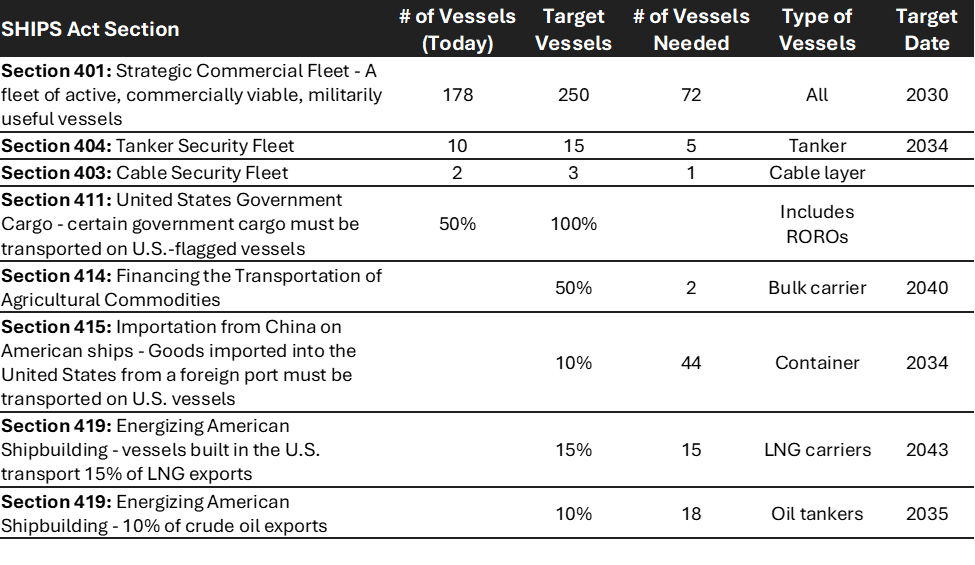
A bipartisan effort is underway to revitalize U.S. commercial shipping and shipbuilding in response to China’s growing maritime dominance. Three major policy initiatives drive this effort: the ongoing Section 301 trade investigation, which imposes fees on Chinese vessels; the April 2025 Restoring America’s Maritime Dominance Executive Order, which requires a Maritime Action Plan by November 2025; and the bipartisan SHIPS for America Act, which targets 250 U.S.-flagged vessels within ten years. These policy initiatives offer hope for sustained, multi-administration support, but their success hinges on corporate willingness to commit to long-term, capital-intensive investments.
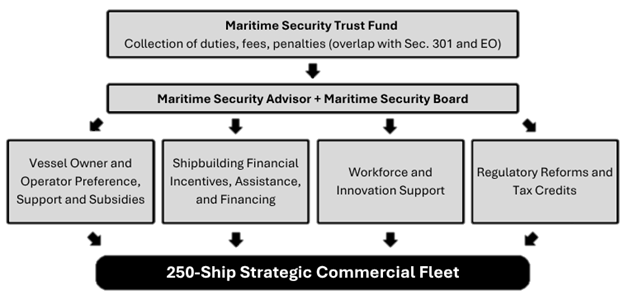
Our analysis indicates that the U.S. needs at least 80 new ships over the next 15 years, requiring a potential increase in production from zero oceangoing ships last year to 15 annually within five years. More ambitious proposals call for up to 1,120 U.S.-flagged vessels to support prolonged international conflict while maintaining economic competitiveness. Global maritime trends, driven primarily by decarbonization, present strategic opportunities for U.S. leadership in sustainable marine fuels, advanced nuclear propulsion, artificial intelligence, digitalization, and autonomous technologies – areas where American innovation can create competitive advantages.
Success requires three complementary strategies: developing a dual-use industrial base that shares supply chains between naval and commercial shipbuilding; technology leapfrogging through advanced manufacturing, robotics, and next-generation maritime systems; and alliance-based approaches, partnering with key countries like Korea, Japan, Canada, and Europe, to leverage their production capacity and expertise, including technology transfer.
Three priority actions are identified:
- Invest in rigorous analysis and assessments to identify viable strategic commercial fleet pathways, considering domestic production, allied procurement, and reflagging approaches.
- Prioritize passage of the SHIPS for America Act to secure a comprehensive, well-funded approach that includes support for maritime innovation at scale.
- Engage educational institutions to build a holistic strategy integrating research, workforce development, and policy activities.
These coordinated steps provide a necessary first step for strengthening America’s strategic commercial fleet, revitalizing U.S. shipbuilding, and establishing leadership in advanced maritime technologies.